A diode is a semiconductor device which allows current to flow through it in only one direction. Although a transistor is also a semiconductor device, it does not operate the way a diode does. A diode is specifically made to allow current to flow through it in only one direction. Some ways in which the diode can be used as:
1. Rectifier, converts Alternating Current, AC to Direct Current, DC for a power supply device.
2. Separate the signal from radio frequencies.
3. An on/off switch that controls current.
1. Rectifier, converts Alternating Current, AC to Direct Current, DC for a power supply device.
2. Separate the signal from radio frequencies.
3. An on/off switch that controls current.
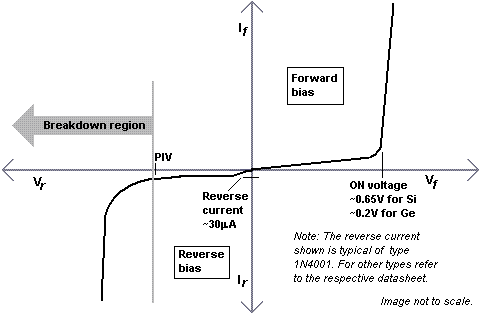
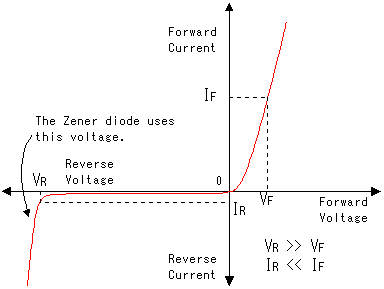
When a small voltage is applied to the diode in the forward direction, current flows easily. Because the diode has a certain amount of resistance, the voltage will drop slightly as current flows through the diode. A typical diode causes a voltage drop of about 0.6 - 1V (VF) (In the case of silicon diode, almost 0.6V) This voltage drop needs to be taken into consideration in a circuit which uses many diodes in series. Also, the amount of current passing through the diodes must be considered.
When voltage is applied in the reverse direction through a diode, the diode will have a great resistance to current flow. Different diodes have different characteristics when reverse-biased. A given diode should be selected depending on how it will be used in the circuit.The current that will flow through a diode biased in the reverse direction will vary from several mA to just µA, which is very small.
The limiting voltages and currents permissible must be considered on a case by case basis. For example, when using diodes for rectification, part of the time they will be required to withstand a reverse voltage. If the diodes are not chosen carefully, they will break down.
When voltage is applied in the reverse direction through a diode, the diode will have a great resistance to current flow. Different diodes have different characteristics when reverse-biased. A given diode should be selected depending on how it will be used in the circuit.The current that will flow through a diode biased in the reverse direction will vary from several mA to just µA, which is very small.
The limiting voltages and currents permissible must be considered on a case by case basis. For example, when using diodes for rectification, part of the time they will be required to withstand a reverse voltage. If the diodes are not chosen carefully, they will break down.

The stripe stamped on one end of the diode shows indicates the polarity of the diode.
The stripe shows the cathode side.
Current flows from the anode side to the cathode side.
The stripe shows the cathode side.
Current flows from the anode side to the cathode side.
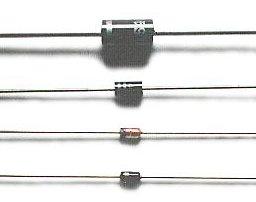
The top two devices shown in the picture are diodes used for rectification. They are made to handle relatively high currents. The device on top can handle as high as 6A, and the one below it can safely handle up to 1A. However, it is best used at about 70% of its rating because this current value is a maximum rating.
The third device from the top (red color) has a part number of 1S1588. This diode is used for switching, because it can switch on and off at very high speed. However, the maximum current it can handle is 120 mA. This makes it well suited to use within digital circuits. The maximum reverse voltage (reverse bias) this diode can handle is 30V.
The device at the bottom of the picture is a voltage regulation diode with a rating of 6V. When this type of diode is reverse biased, it will resist changes in voltage. If the input voltage is increased, the output voltage will not change. (Or any change will be an insignificant amount.) While the output voltage does not increase with an increase in input voltage, the output current will. This requires some thought for a protection circuit so that too much current does not flow. The rated current limit for the device is 30mA. Generally, a 3-terminal voltage regulator is used for the stabilization of a power supply. Therefore, this diode is typically used to protect the circuit from momentary voltage spikes. 3 terminal regulators use voltage regulation diodes inside.
The third device from the top (red color) has a part number of 1S1588. This diode is used for switching, because it can switch on and off at very high speed. However, the maximum current it can handle is 120 mA. This makes it well suited to use within digital circuits. The maximum reverse voltage (reverse bias) this diode can handle is 30V.
The device at the bottom of the picture is a voltage regulation diode with a rating of 6V. When this type of diode is reverse biased, it will resist changes in voltage. If the input voltage is increased, the output voltage will not change. (Or any change will be an insignificant amount.) While the output voltage does not increase with an increase in input voltage, the output current will. This requires some thought for a protection circuit so that too much current does not flow. The rated current limit for the device is 30mA. Generally, a 3-terminal voltage regulator is used for the stabilization of a power supply. Therefore, this diode is typically used to protect the circuit from momentary voltage spikes. 3 terminal regulators use voltage regulation diodes inside.
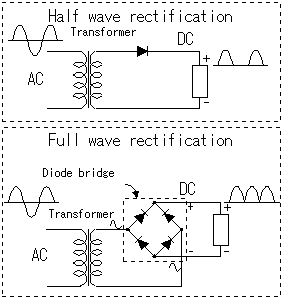
Rectification diodes are used to make DC from AC. It is possible to do only 'half wave rectification' using 1 diode. When 4 diodes are combined, 'full wave rectification' occurrs. Devices that combine 4 diodes in one package are called diode bridges. They are used for full-wave rectification.
